Blog
Types of Router Bits Every Woodworking Beginner Should Know

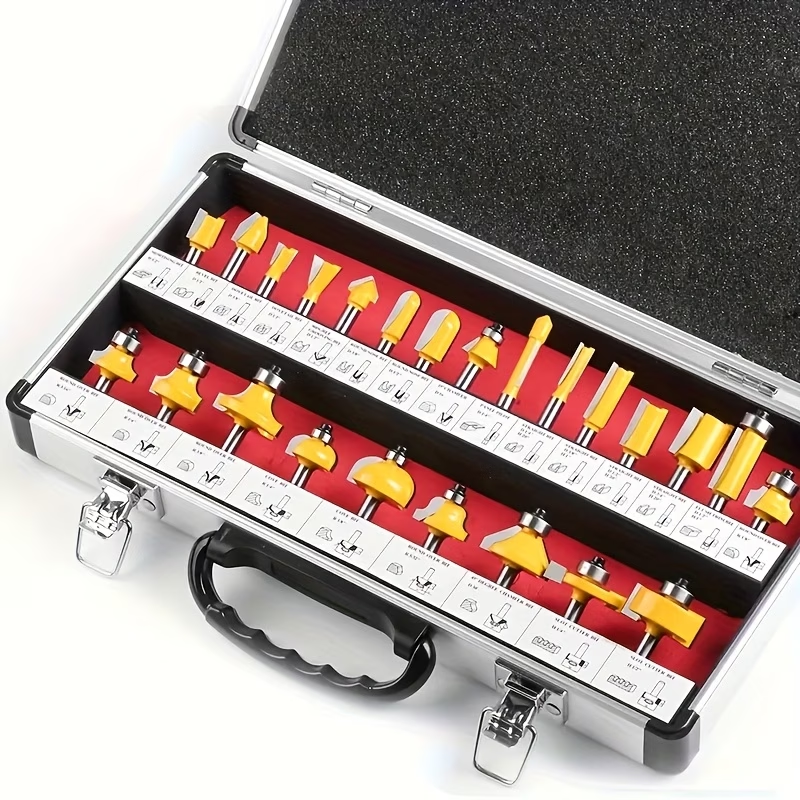
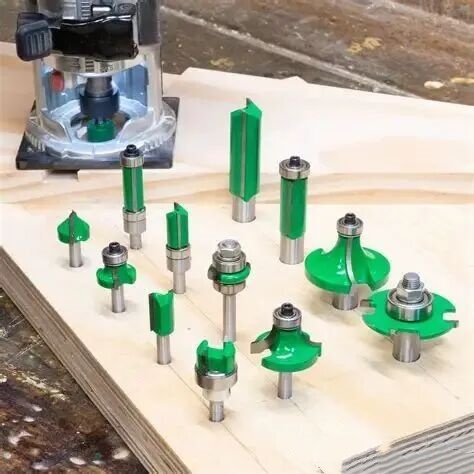
Router bits are the core cutting tools of any woodworking routing setup. They install onto handheld wood routers and CNC carving machines, and shape, trim, groove and contour wooden workpieces. For newcomers, learning the main router bit types for beginners is the first step toward stable, high-quality results, and woodworking router bits for beginners are exactly where this guide starts. We walk through six essential bit types, how each works, and the safety rules every starter should follow.
Choosing the correct bit among woodworking router bits for beginners improves accuracy, simplifies production steps, and makes finished woodwork look far more professional. Below we cover the tools that handle most daily grooving, trimming, edge finishing and decorative molding tasks.
What Is a Woodworking Router Bit?
A woodworking router bits for beginners is a specialized rotary cutting tool matched with handheld routers, bench routers and CNC wood carving machines. Driven by high-speed spindle rotation, its cutting edges remove excess wood to create precise grooves, clean edges and custom contour shapes on wood surfaces.
Unlike fixed cutting tools, router bits offer flexible molding capabilities. They complete linear grooving, edge trimming, arc contouring and decorative molding in one or multiple passes. Understanding each bit’s function helps beginners control details, avoid errors, and build confidence across projects.
Woodworking Router Bits for Beginners: The 6 Essential Types
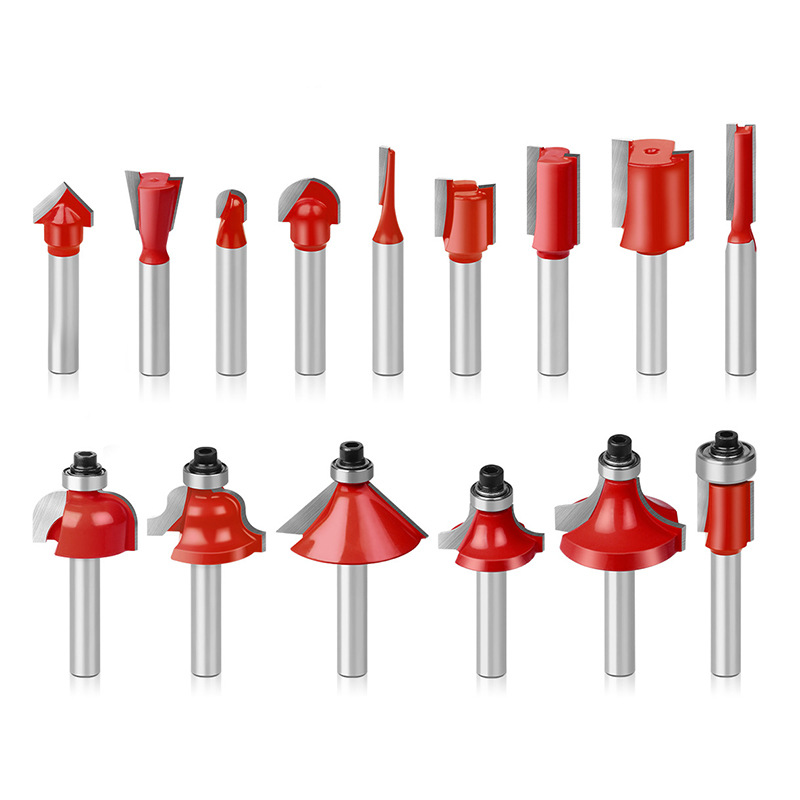
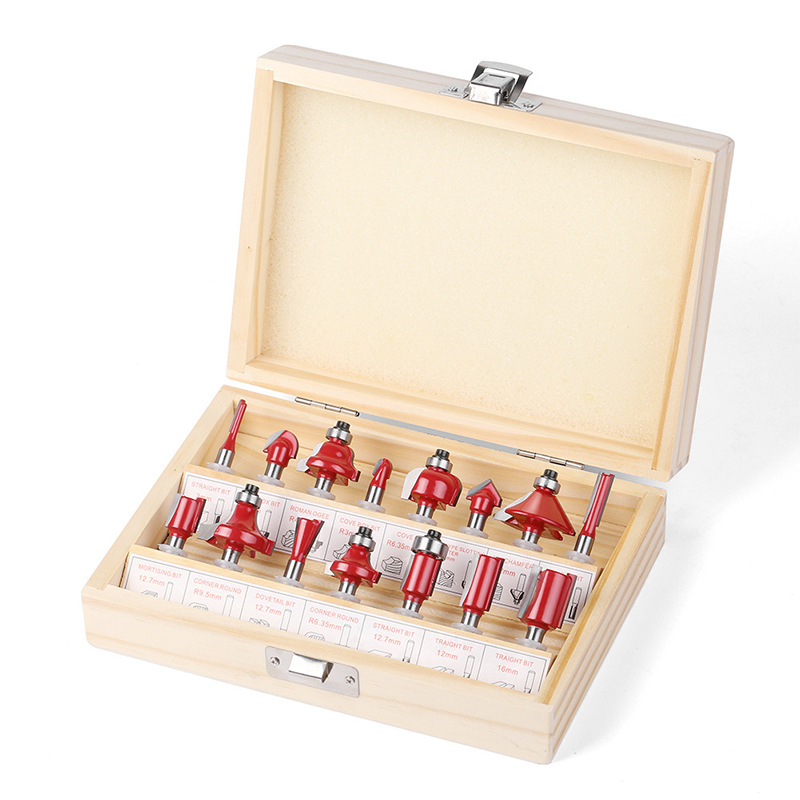
Six universal woodworking router bits for beginners cover most entry-level woodworking and DIY scenarios. Each has distinct structure and exclusive advantages.
1. Straight Bit
The straight bit is the most fundamental and versatile tool in woodworking routing, with straight parallel cutting edges and no arc or angle deformation. It is mainly used for linear grooving, dado cutting and mortise processing, and is indispensable for tenon-and-mortise joint production.
This bit cuts standard flat-bottom grooves and neat mortise holes on solid wood, plywood and MDF panels. It works well for splicing joints, reserving assembly grooves and digging embedded channels. Best use: Creating precise grooves and mortises for tenon-and-mortise wood joining structures.
2. Flush Trim Bit
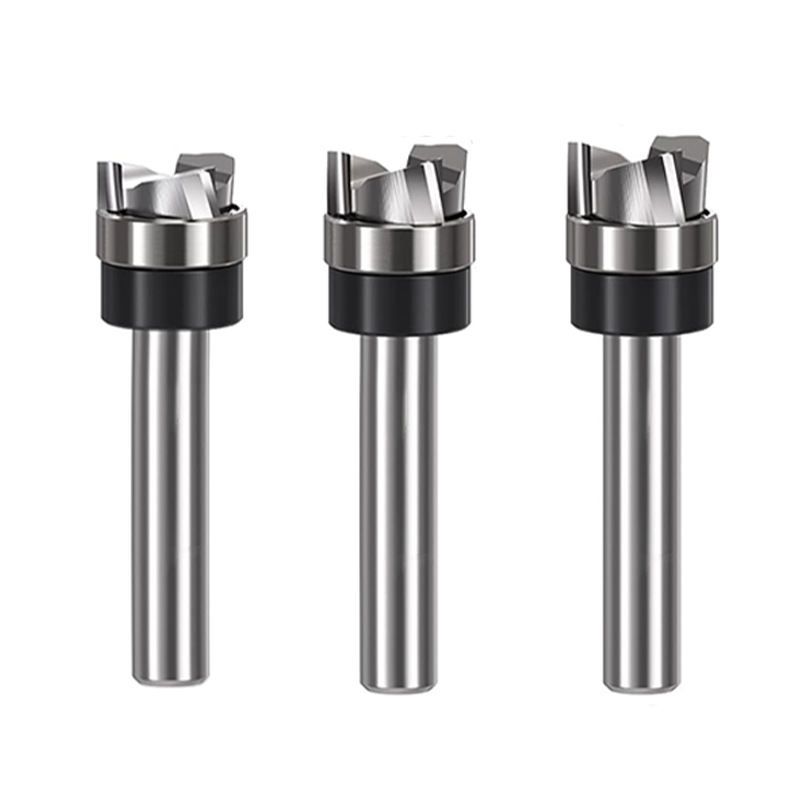
Also called a template trim bit, the flush trim bit has a precision ball bearing at the end. The bearing fits template edges, workpiece contours or finished reference surfaces, achieving zero-error follow-up cutting.
During operation, the bearing runs along the fixed reference edge while the cutting edge trims excess material. The result is a surface completely flush and flat with the reference template. Best use: Template routing, veneer edge trimming and flush finishing for laminated panels.
3. Roundover Bit
The roundover bit is a professional edge finishing tool with a circular arc cutting design. It polishes sharp right-angle edges into smooth, rounded arc surfaces, removing burrs and hard corners left after cutting.
It is the simplest, most efficient way to improve a workpiece’s appearance. The rounded edge boosts tactile comfort and avoids collision scratches. Best use: Softening sharp edges and adding refined decorative details to daily woodwork.
4. Chamfer Bit
Unlike arc roundover bits, the chamfer bit uses a linear bevel cutting structure, with 45 degrees being the most common angle. It cuts neat, uniform inclined edges with distinct lines and strong three-dimensional layering.
This bit blends practicality and decoration. It pre-processes beveled edges for tenon splicing and creates regular decorative bevels on furniture surfaces. Best use: Making decorative edge lines and pre-processing beveled edges for assembly.
5. Cove Bit
The cove bit is a decorative molding tool with an inward concave arc cutting edge. It carves smooth, elegant concave contour lines, making it the core tool for furniture decorative lines and special-shaped trim strips.
Woodworkers combine cove bits with roundover and chamfer bits to build complex, layered composite contours. Best use: Producing decorative line details for cabinets, tables and customized furniture.
6. Rabbeting Bit
The rabbeting bit is a functional grooving tool with a positioning ball bearing, used for step-shaped rabbet grooves along panel edges. The built-in bearing controls cutting depth to keep groove width and depth consistent.
Rabbet grooves are widely used for embedded assembly of wood structures, making splicing tighter and more stable. Best use: Processing rabbet joints for boxes, cabinet backboards and drawer bottoms.
Critical Safety Tips for Using Router Bits
Router bits spin at ultra-high speed. Standardized operation protects both quality and personal safety. For woodworking router bits for beginners, these rules matter most to avoid accidents and tool damage.
- Adopt conventional cutting direction. Always cut against the router bit’s rotation. Forward climb milling is risky for beginners and causes tool jumping, workpiece displacement and edge chipping.
- Take multiple shallow cuts. Avoid one-time deep grooving. Layered shallow processing lowers resistance, prevents overheating and keeps cutting surfaces neat.
- Use a router table for small workpieces. Small parts shake and pop up during handheld work. A router table improves stability and safety.
- Wear protective equipment. Always wear safety goggles and earmuffs to block flying chips and reduce noise damage.
- Set the tool down only after a full stop. Wait for the bit to stop rotating before placing the router to avoid accidental scratches.
Conclusion
Mastering woodworking router bits for beginners is a necessary skill for every new woodworker. Straight, flush trim, roundover, chamfer, cove and rabbeting bits cover almost all basic routing needs: grooving, trimming, edge finishing and decorative molding.
Familiarity with each bit’s traits helps beginners select tools by project, raise efficiency and quality, and build a foundation for advanced work. Following standardized safety rules ensures long-term, stable and safe woodworking production.
FAQ
Q1: Which router bit is most suitable for beginner woodworkers?
Straight bits and flush trim bits are the most practical. They are easy to operate and cover basic grooving and trimming for most daily projects.
Q2: What is the difference between a roundover bit and a chamfer bit?
A roundover bit creates smooth curved rounded edges for soft decoration, while a chamfer bit cuts straight 45° beveled edges with a neat, stylish linear effect.
Q3: Why avoid one-time deep cutting with router bits?
One-time deep cutting increases resistance, causes overheating and blade wear, and easily leads to edge chipping and uneven surfaces.
Q4: What is a rabbeting bit used for?
Rabbeting bits process edge step grooves (rabbet joints), widely used for assembling boxes, cabinet backboards and drawer bottoms.