Traditional Defects of Guide Sleeve Template Milling
In traditional woodworking template processing, many workshops rely on guide sleeves to cooperate with straight router bits for profiling cutting. Although this combination can complete basic copying work, it has inherent dimensional deviation problems. The guide sleeve itself has a certain wall thickness and offset distance, which will affect the final forming size of the workpiece.
To compensate for the offset of the guide sleeve, workers must make the template size smaller than the final finished workpiece in advance. This requires complicated calculation and repeated trial cutting correction during jig production, which not only increases the production difficulty of the template, but also easily causes dimensional errors in mass production. For high-precision custom woodwork, the matching mode of straight router bits plus guide sleeves has obvious limitations.
Zero Offset Advantage of Bearing-Guided Trimming Router Bits
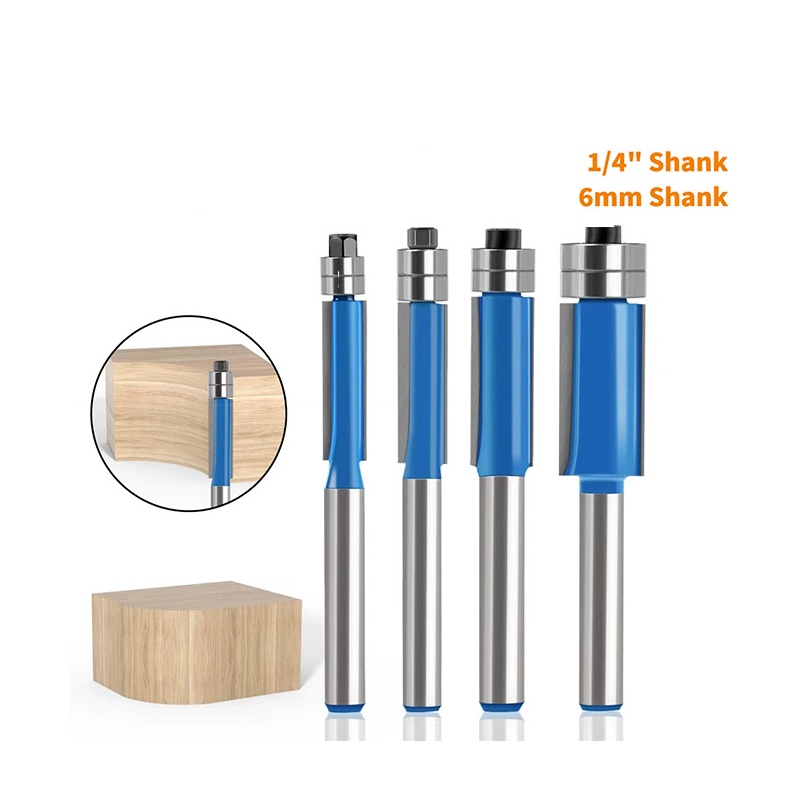
Trimming router bits with bearing guides completely solve the offset problem of traditional guide sleeve processing. The outer diameter of the tool bearing is accurately matched with the cutting edge trajectory, and there is no virtual offset distance during template fitting. Workers can directly set the template size equal to the final workpiece size without reserved error compensation.
This feature greatly simplifies template production procedures. The jig design no longer requires complicated size conversion, and one template can complete accurate copying and forming. In actual operation, trimming router bits can fit the template stably, avoid trajectory deviation, and make the contour of each workpiece completely consistent with the template design standard. The processing accuracy and yield are far higher than the traditional matching mode of straight router bits and guide sleeves.
Practical Value for Batch Production
For cabinet factories, customized wood workshops and jig mass production lines, bearing-guided trimming router bits reduce repeated debugging and template modification work. The zero-offset fitting feature stabilizes the processing benchmark, makes batch workpiece sizes unified, and effectively reduces defective products caused by template errors. Cooperating with reasonable specifications of woodworking router bits can greatly improve the standardization level of profiling processing.