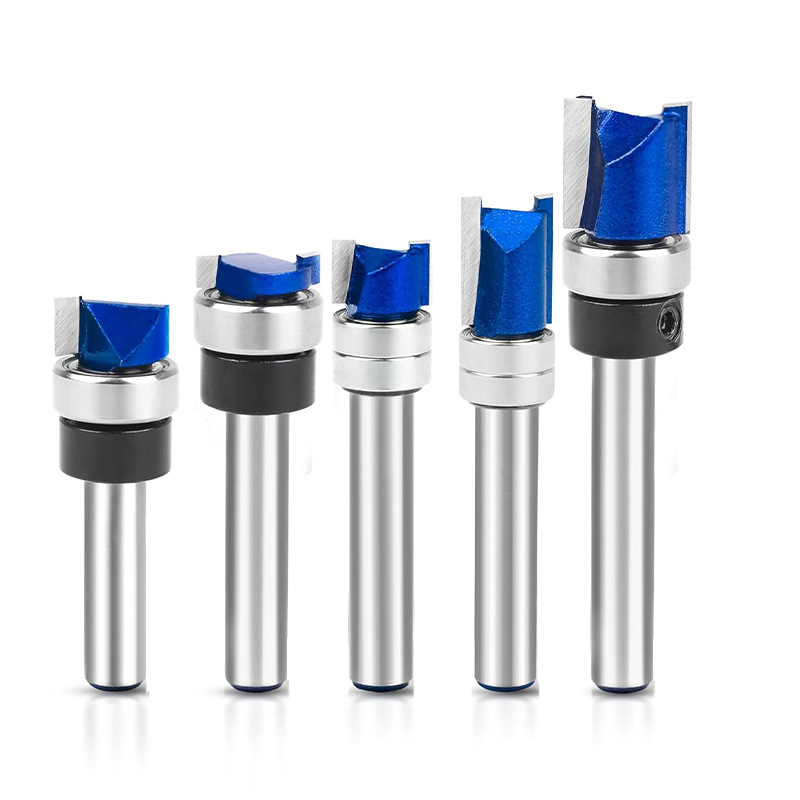
Structural Classification of Bearing-Guided Trimming Router Bits
Trimming router bits are mainly divided into bottom bearing and top bearing structures according to the bearing installation position, and the two types of woodworking router bits correspond to completely different processing techniques and operation habits. Many woodworkers confuse the two structures, resulting in incorrect fitting directions and poor trimming effects in actual processing.
Tools with bearings installed at the bottom of the cutter body are usually defined as template profiling router bits. This structural design allows the bottom bearing to cling to the template surface, and the upper cutting edge completes workpiece milling. It is very suitable for large-area template copying, special-shaped contour processing and batch customized workpiece forming, and is one of the most commonly used woodworking router bits in jig matching processing.
Application and Operation Essentials of Flush Trimming Router Bits
Top bearing flush trimming router bits are more focused on on-site assembly and edge finishing. The top bearing fits the flat reference surface of the finished board, and the lower cutting edge trims the excess margin of the board. This tool structure is specially designed for flush fitting of board edges, widely used in cabinet edge trimming, countertop joint processing and veneer finishing.
Different from straight router bits that need to rely on external positioning tools, trimming router bits complete positioning and cutting integration through their own bearing structure. During operation, keep the bearing closely fitted to the reference surface at a constant speed, avoid shaking and sudden acceleration, which can obtain ultra-clean cutting edges without burrs or chipping.
Reasonable Matching of Trimming Router Bits and Straight Router Bits
In a complete woodworking processing system, trimming router bits and straight router bits cooperate with each other to cover all processing links. Straight router bits undertake standard grooving, through cutting and rough material removal work. Trimming router bits are responsible for high-precision finishing, edge flush correction and template profiling copying.
Mastering the structural differences and operating scenarios of different woodworking router bits can help workers quickly select matching tools according to processing needs, avoid tool misuse, improve overall processing efficiency, and ensure stable and reliable finished product quality.