Understanding Bearing-Guided Trimming Router Bits in Woodworking
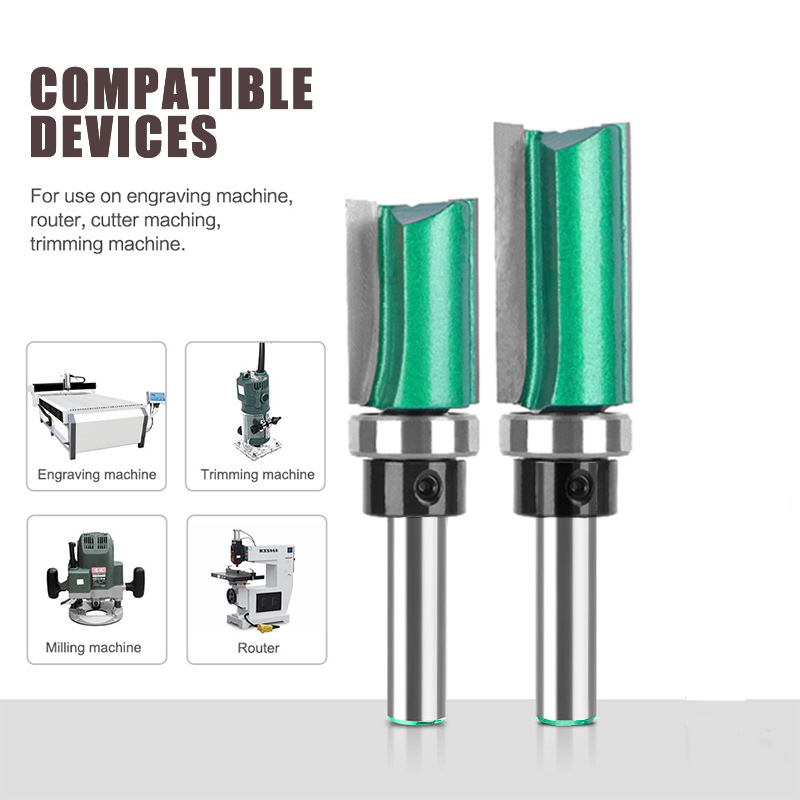
Among all woodworking router bits, trimming router bits with built-in bearing guides are the most practical and process-oriented tools for on-site woodworking and custom furniture production. Different from standard straight router bits that rely entirely on machine fences for positioning, trimming router bits integrate a precision guide bearing at the tool end, which enables self-positioning and edge-following processing. This unique structural design makes these woodworking router bits irreplaceable in many high-precision finishing and profiling tasks.
Many woodworkers only use straight router bits for all milling operations, resulting in low precision, inconsistent edges and tedious repeated calibration. Knowing the applicable scenarios of bearing-guided trimming router bits can greatly simplify processing steps, improve finished surface quality and reduce on-site debugging time.
Core Advantage Scenario 1: Wood Flush Trimming Operations
Flush trimming is the most classic and widely used scenario for trimming router bits. This process requires trimming excess board edges to achieve a perfectly flush and seamless fit between two adjacent wood surfaces, which is common in countertop installation, cabinet assembly and veneer finishing.
Bearing-guided trimming woodworking router bits are professionally optimized for flush trimming tasks. The precision bearing closely fits the finished reference surface, while the exposed cutting edge accurately removes excess material. Compared with straight router bits operated by manual fence adjustment, trimming router bits produce cleaner cutting lines, flatter edges and zero height deviation. For on-site installation work that requires high flatness, these woodworking router bits are the most efficient solution.
Core Advantage Scenario 2: Template Copying and Profile Milling
Template profiling is another key application that highlights the value of bearing-guided trimming router bits. In batch furniture production and custom wood shaping, workers often use fixed templates to replicate unified contour shapes. The bearing structure of trimming router bits can closely follow the template outline to complete automatic profiling milling.
Unlike straight router bits that require repeated parameter setting and fence calibration, trimming router bits realize one-to-one shape copying. Whether it is curved contour cutting, special-shaped edge forming or standardized workpiece replication, bearing-guided woodworking router bits can ensure consistent size and uniform contour for each processed piece, greatly improving batch production consistency.
Judgment Rules for Tool Selection
Straight router bits are more suitable for standard grooving, through cutting and fixed-size material removal with stable fence positioning. When the processing task involves edge fitting, on-site flush correction, template copying and irregular contour finishing, trimming router bits with bearing guides should be prioritized. Mastering this selection logic allows woodworking router bits to exert their maximum process advantages in different working conditions.