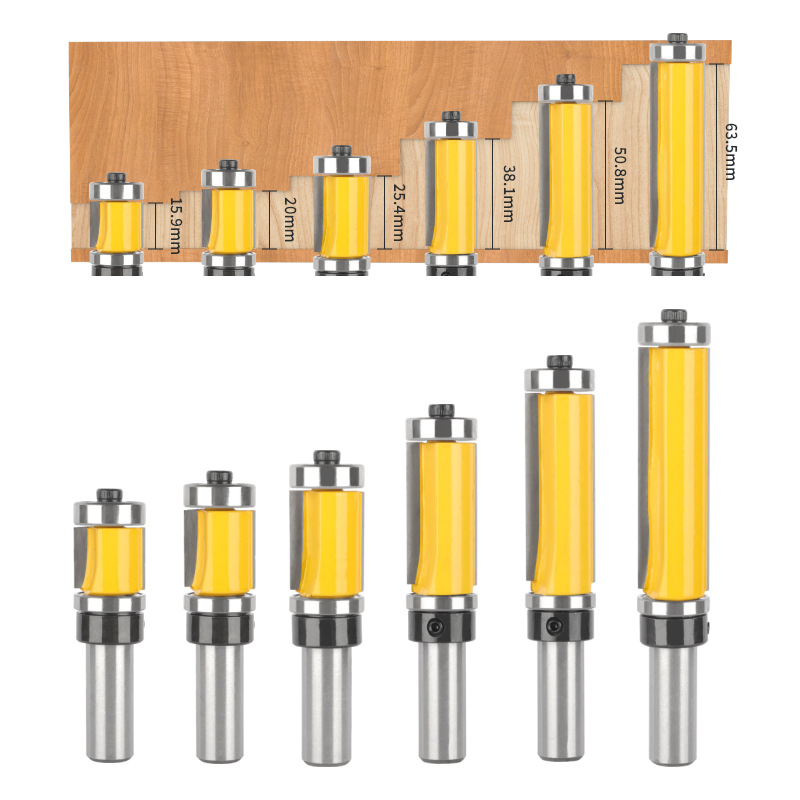
How Cutting Edge Length Determines Processing Performance
When selecting trimming router bits and matching straight router bits for woodworking processing, cutting edge length is one of the most easily overlooked but critical parameters. The effective cutting length directly determines the maximum processing depth, workpiece thickness adaptability and operational stability of woodworking router bits. Different edge length designs correspond to completely different processing scenarios, which directly affect production efficiency and finished product quality.
Long-edge trimming router bits feature extended cutting flute design, which can process thicker wood blanks and complete deep forming structures and deep mortise grooving that short-edge tools cannot achieve. In furniture joinery processing, deep tenon grooves and embedded structural grooves all rely on long-flute woodworking router bits for one-time forming. This tool structure reduces secondary repeated cutting procedures and improves the overall continuity of processing.
Stability Differences Between Long and Short Cutting Edges
Long-edge trimming router bits have a wider processing range, but they have obvious limitations in operational stability. The extended cutting arm increases the tool’s suspension length during high-speed rotation, making woodworking router bits more prone to vibration and shaking. Slight tool chatter will lead to uneven groove walls, edge ripples and reduced processing precision, especially obvious in high-speed CNC continuous cutting.
In contrast, short-edge trimming router bits have excellent structural stability. The compact cutting flute design effectively reduces tool shaking and vibration during operation, maintaining stable cutting accuracy for a long time. Short-flute woodworking router bits are most suitable for shallow groove processing, surface trimming and shallow dado cutting. These processes have low depth requirements but high standards for flatness and smoothness, which perfectly matches the stable performance of short-edge trimming router bits.
Scenario-Based Matching Rules for Edge Length
In actual production, deep forming and thick material processing should choose long-flute trimming router bits to ensure one-time cutting in place. Shallow grooving, edge finishing and high-precision surface trimming must prioritize short-flute woodworking router bits to avoid tool vibration defects. Reasonable matching of cutting edge length can maximize the performance advantages of trimming router bits and straight router bits, avoiding quality problems caused by improper tool selection.