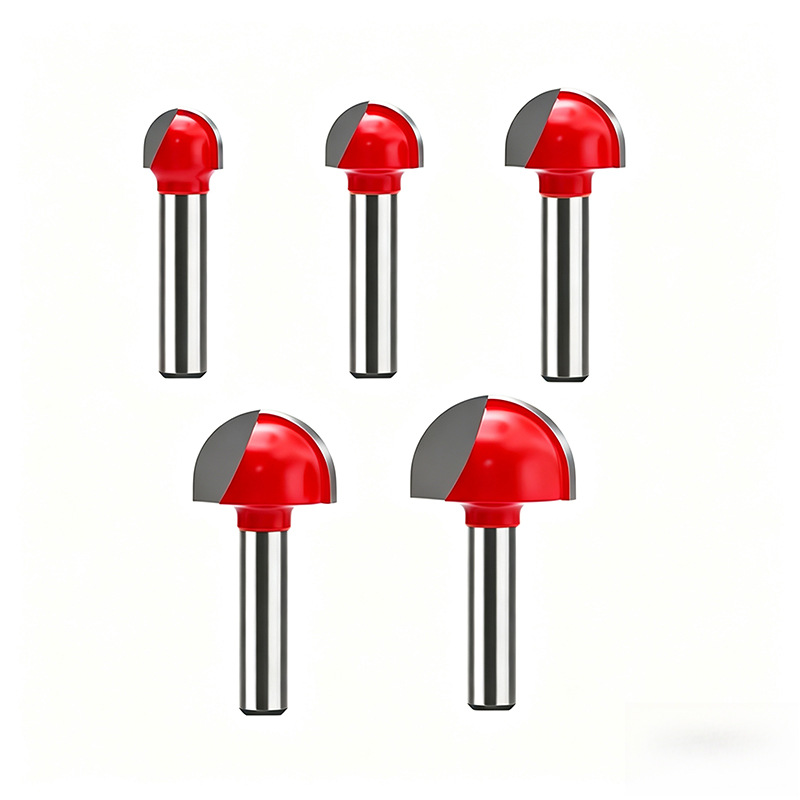
How to Match Processes and Parameters for CNC Wood Router Bit Selection
Different woodworking processes and machining parameters require exclusive CNC wood router bit configurations. Many processing quality problems such as incomplete cutting, edge chipping and rough surface are not caused by tool quality defects, but by mismatched tool models and processing technologies. Understanding the matching logic between cutting processes and woodworking router bit parameters helps manufacturers select scientific and efficient tools for different production links.
First, clarify the specific cutting operation type to determine the applicable woodworking router bit category. Woodworking CNC processing is divided into roughing, finishing, carving and 3D contour machining, with completely different tool requirements. Roughing processing focuses on rapid material removal, requiring woodworking router bits with large cutting volume and strong rigidity. Large-diameter straight bits and roughing spiral bits are commonly used for batch blanking and grooving, improving production efficiency with high material removal rate.
Finishing processing takes surface precision and flatness as the core standard, requiring woodworking router bits with precise grinding and stable cutting balance. Multi-flute finishing bits and compression woodworking router bits can eliminate upper and lower edge burrs, ensuring smooth workpiece sections without secondary polishing. For professional creative processes such as pattern carving and 3D relief modeling, ball nose bits and special-shaped engraving woodworking router bits are required. Their unique arc and special geometric structures can complete fine detail processing that ordinary straight bits cannot achieve.
Tool diameter is a key parameter balancing processing efficiency and detail performance. Large-diameter CNC wood router bits have strong cutting rigidity and fast material removal speed, suitable for large-area board cutting and wide-groove processing, greatly shortening production cycle. However, oversized tools cannot adapt to complex patterns, narrow grooves and fine gap processing, easy to cause over-cutting and pattern distortion. Small-diameter woodworking router bits excel in detailed carving and precise grooving, capable of completing complex and delicate woodwork designs, but the cutting area is small and the overall processing time is relatively longer.
Cutting depth determines the ultimate working range of woodworking router bits. Each type of CNC wood router bit has a designed safe cutting depth. Some thin and delicate carving tools are only suitable for shallow cutting and surface trimming. For deep grooving, through-cutting and thick-board processing, users must select extended-length woodworking router bits with strong rigidity to avoid tool shaking, tool breakage and uneven cutting caused by excessive depth.
Spindle speed and feed rate parameter matching cannot be ignored. Every woodworking router bit has factory-recommended speed and feed ranges adapted to its material and structure. High-rigidity carbide woodworking router bits can withstand high-speed operation above 10000 RPM, matching fast feed processing to improve efficiency. Ordinary high-speed steel tools are not suitable for ultra-high-speed cutting, which easily causes blade overheating and wear. Excessively fast feed rate leads to edge chipping and tool vibration, while excessively slow feed rate causes tool heating and board burning. Only matching tools with scientific operating parameters can maintain stable processing effect and extend tool service life.
In actual production, enterprises need to classify processes, distinguish roughing and finishing, separate coarse and fine processing, and match corresponding woodworking router bits and operating parameters. Process-oriented tool selection can effectively avoid resource waste and processing risks, realizing efficient and standardized production.