Analysis and Solutions of Base Board Damage and Guide Failure
Base board damage and bearing guide failure are the two most frequent defects in bearing-guided woodworking router bit processing. This problem mainly occurs when the cutting length of trimming router bits is greater than the workpiece thickness. Improper tool height adjustment either causes the tool tip to scratch the bottom support board or makes the bearing detach from the template and lose positioning accuracy.
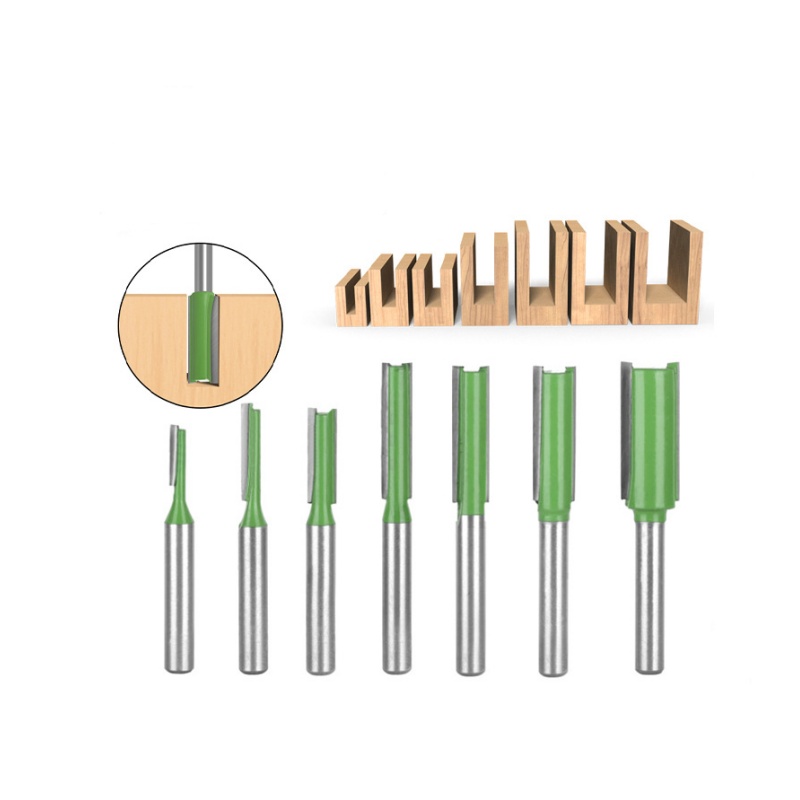
The fundamental solution is to match processing tools and auxiliary templates according to plate specifications. For thin plate processing with long-flute trimming woodworking router bits, use thickened templates to lift the equipment to reserve tool tip space, or flip the workpiece to change the template fitting surface and cooperate with reverse positioning trimming router bits. For fixed-thickness batch processing, replace straight router bits with matched cutting length for through cutting to avoid redundant tool edge contact.
Wood Tearout and Grain Cutting Defect Correction
Wood fiber tearout and edge burrs are typical quality problems in template milling, mostly caused by unreasonable feeding direction and grain conflict. Many operators blindly adjust tool parameters or replace woodworking router bits, but ignore the matching relationship between feeding direction and wood grain.
Reverse feeding is prohibited in table router processing, which will cause dangerous climb cutting and aggravate fiber tearing. The correct optimization method is to flip the workpiece to adjust the template position, and replace the corresponding upper and lower bearing trimming router bits to adapt to the new fitting direction. This method maintains standard forward feeding and uses the precise shearing performance of high-quality woodworking router bits to obtain smooth cutting edges.
Efficiency Optimization for Frequent Tool Replacement Problems
Frequent tool disassembly, replacement and calibration are important factors restricting processing efficiency in complex milling projects. Single-function straight router bits and single-sided bearing trimming router bits cannot adapt to flexible switching of upper and lower templates. Repeated tool setting will cause tool position deviation and affect batch processing consistency.
Equipping dual-bearing hybrid trimming woodworking router bits can completely solve this problem. The dual-direction bearing design integrates all profiling and trimming functions, realizing one-tool multi-purpose processing. It eliminates repeated tool replacement and debugging links, stabilizes processing benchmarks, and greatly improves the overall efficiency and yield of customized wood processing projects.
Summary of Standardized Processing Logic
All common defects in bearing-guided router milling can be solved through standardized tool matching and process adjustment. Straight router bits undertake conventional fixed-depth cutting, while different types of trimming router bits adapt to template positioning processing. Mastering targeted troubleshooting methods can maximize the performance of woodworking router bits, ensure processing safety and finished product quality, and optimize workshop production efficiency.