Different Working Principles of Two Positioning Milling Systems
Workshop template milling mainly relies on two positioning modes: guide sleeve cooperation with straight router bits, and integrated bearing-guided trimming router bits. The two sets of woodworking processing systems have completely different structural principles, accuracy characteristics and applicable scenarios, which determine the processing quality and operational safety of woodwork pieces.
The guide sleeve positioning mode adopts external auxiliary positioning structure. The guide sleeve is fixed on the equipment base, and the straight router bit extends out of the sleeve hole for cutting. The sleeve wall thickness forms a fixed offset distance between the tool trajectory and the template. This structural feature requires manual size compensation for the template, which has high technical requirements for workers and is prone to dimensional errors.
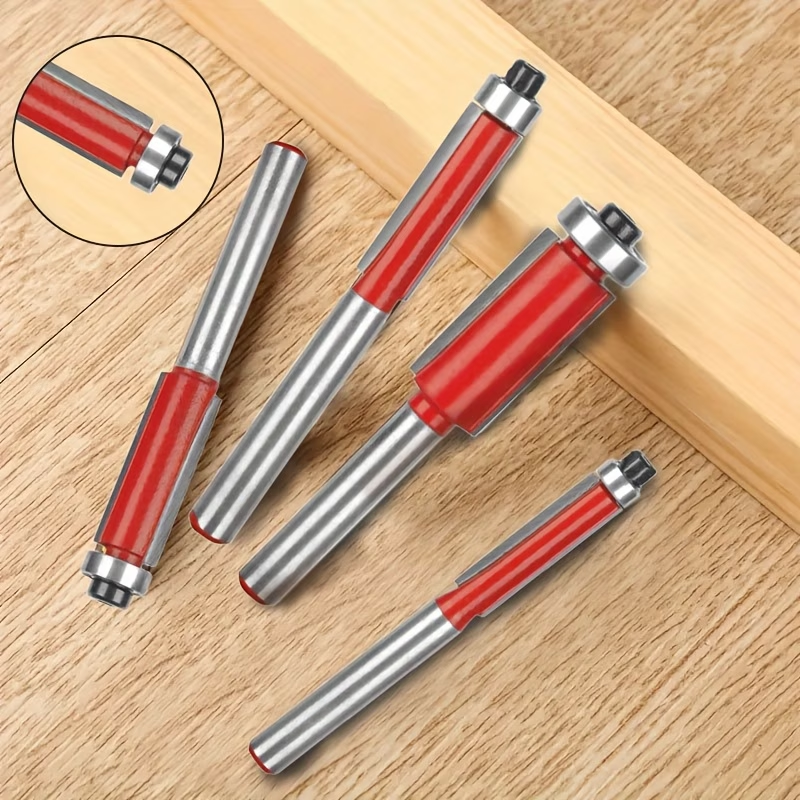
Bearing-guided trimming woodworking router bits adopt integrated self-positioning design. The bearing and cutting edge are precisely concentrically matched without extra offset error. The template size can be completely consistent with the finished workpiece size, eliminating the need for complicated size conversion and error compensation. The positioning accuracy and operation simplicity are far better than the guide sleeve and straight router bits combination.
Scenario-Based Selection Rules for Workshop Production
Guide sleeve matching straight router bits is suitable for large-scale standardized template production with fixed offset parameters. After the template is calibrated in batches, it can meet the needs of mass repetitive processing, and the tool cost is low, which is suitable for factory assembly line production with fixed processes.
Bearing-guided trimming router bits are more suitable for customized processing, on-site installation and multi-style small-batch production. It has no offset limitation, flexible template production, simple debugging process and high finished product qualification rate. For high-precision edge trimming, special-shaped profiling and on-site modification operations, trimming woodworking router bits are the preferred solution.
Comprehensive Benefits of Reasonable Tool Matching
Grasping the difference between guide sleeve positioning and bearing-guided positioning can help workshops build a scientific woodworking router bit matching system. Reasonable use of straight router bits and trimming router bits according to processing scenarios can not only improve processing accuracy and production efficiency, but also avoid operational safety risks caused by tool mismatch, realizing cost reduction and efficiency improvement in wood processing.