


Blog
Industrial‑Grade Woodworking Router Bits vs DIY Router Bits: Key Differences for Wood Furniture Production

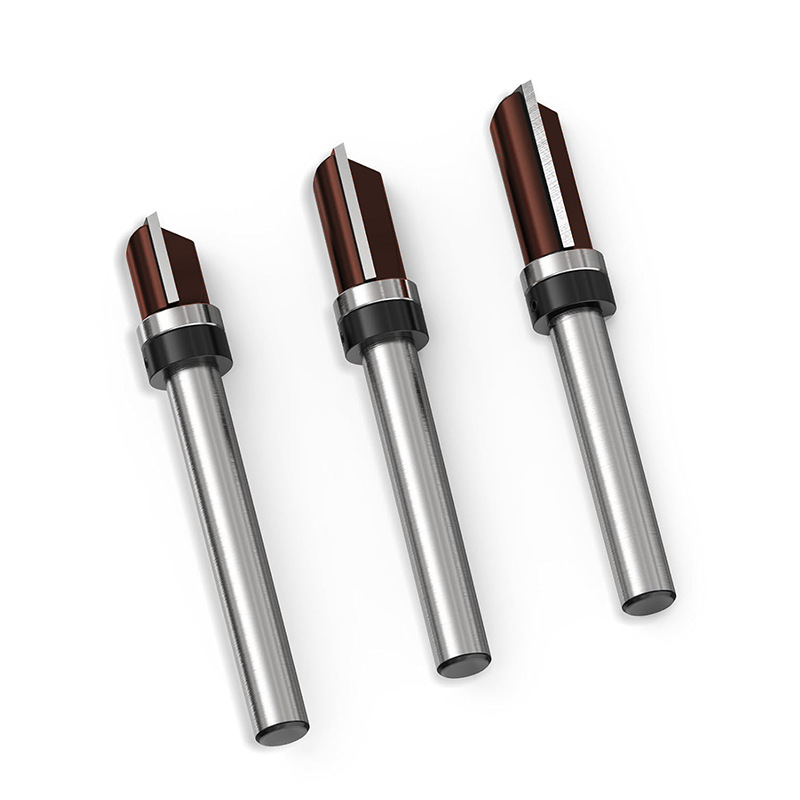
Many buyers confuse industrial‑grade woodworking router bits with common DIY router bits.
For furniture workshops, cabinet factories and home wood‑making enthusiasts, woodworking router bits are essential consumables for all kinds of wood shaping work. Many purchasers tend to judge tool quality only by surface sharpness. In fact, sharpness is only one index. Working condition, material composition, coaxial tolerance and chip removal structure determine the overall performance of woodworking router bits in real production.
Material selection forms the most fundamental gap between industrial‑grade woodworking router bits and DIY router bits. Most industrial woodworking router bits adopt micro‑grain tungsten carbide welding or solid carbide structure. These materials own outstanding heat resistance and abrasive resistance. When processing density board, particle board and laminated panel filled with glue and mineral impurities, the cutting edge will not soften quickly under long‑time high‑speed friction. Many industrial woodworking router bits are treated with anti‑adhesive coating, which reduces resin adhesion and prevents board burning during continuous cutting. Common DIY woodworking router bits mostly use ordinary high‑speed steel. Though brand‑new blades feel sharp, they are poor in high‑temperature resistance. After dozens of cutting cycles on artificial boards, edges will wear rapidly. Most consumer‑level woodworking router bits only adopt anti‑rust surface treatment without functional wear‑resistant coating.
Manufacturing precision and shank tolerance are another obvious distinction. Industrial woodworking router bits are produced with strict grinding standard. Radial run‑out is well controlled, which guarantees stable rotation under high‑speed operation of CNC machines and automatic milling equipment. The shank dimension and total length keep high consistency among batches. When changing multiple woodworking router bits on multi‑spindle devices, operators do not need repeated depth calibration. Good dynamic balance lowers vibration, reduces tool loss and prevents panel chipping and tearing‑out on melamine covered boards. On the contrary, DIY woodworking router bits allow bigger tolerance range. They are designed for intermittent operation of hand‑held trimmers. Under low‑speed short‑time cutting, users may not notice obvious shaking. Once installed on high‑speed industrial equipment, excessive run‑out will bring heavy vibration, bad surface finish and even tool fracture risk.
Cutting geometry and chip‑removal design are optimized for different usage frequency. Industrial woodworking router bits adopt polished large‑capacity chip flute. Chips and hot sawdust can be discharged fast, lowering heat accumulation. Some styles apply special edge geometry to restrain top‑and‑bottom edge chipping for veneer panels. This helps factories cut down subsequent polishing and repairing work. DIY woodworking router bits adopt universal flute structure for cost control. They can finish simple grooving and trimming for small‑batch hand‑made projects. But when facing continuous feeding, chip jam happens easily, which causes board burning and rough cutting surface.
Service life and economic logic vary for two categories of woodworking router bits. Industrial furniture factories run thousands of processing cycles every single day. Industrial woodworking router bits can keep stable dimension for long period, and qualified products support professional re‑grinding for repeated usage. Even if the unit price is higher, the comprehensive cost for each processed workpiece remains low. DIY woodworking router bits are positioned for occasional hobby projects. Users process small quantity of solid wood or simple composite panels. Once the blade turns dull, people usually replace the whole bit directly instead of re‑grinding. Low single‑item purchase price becomes the core advantage for home users.
Application equipment and suitable processing materials should also be taken into consideration. Industrial woodworking router bits match CNC engraving machines, auto feed milling machines and multi‑axis production equipment. They adapt to solid wood, density board, particle board, plywood and various decorative composite panels. DIY woodworking router bits fit hand‑held trimmers and small household bench routers. They perform well for infrequent soft‑wood handicraft making, yet not fit for non‑stop mass production of furniture parts.
It does not mean DIY woodworking router bits are poor‑quality products. Every type of woodworking router bits is developed for its target scenario. Hobbyists do not need to over‑invest in expensive industrial woodworking router bits for several hand‑craft tasks. For furniture factories, using low‑cost consumer‑level woodworking router bits on high‑speed production lines will lead to frequent workpiece scrap, machine abrasion and higher hidden cost. Confirm production volume, equipment type and board material before placing orders, so you can select proper woodworking router bits for your own projects.
If you need, work task mode can help you expand this article into complete blog release materials with matching alt texts and internal link anchor text.