


Blog
Bearing Trim Router Bits: Uses, Structure and Buying Guide for Woodworking

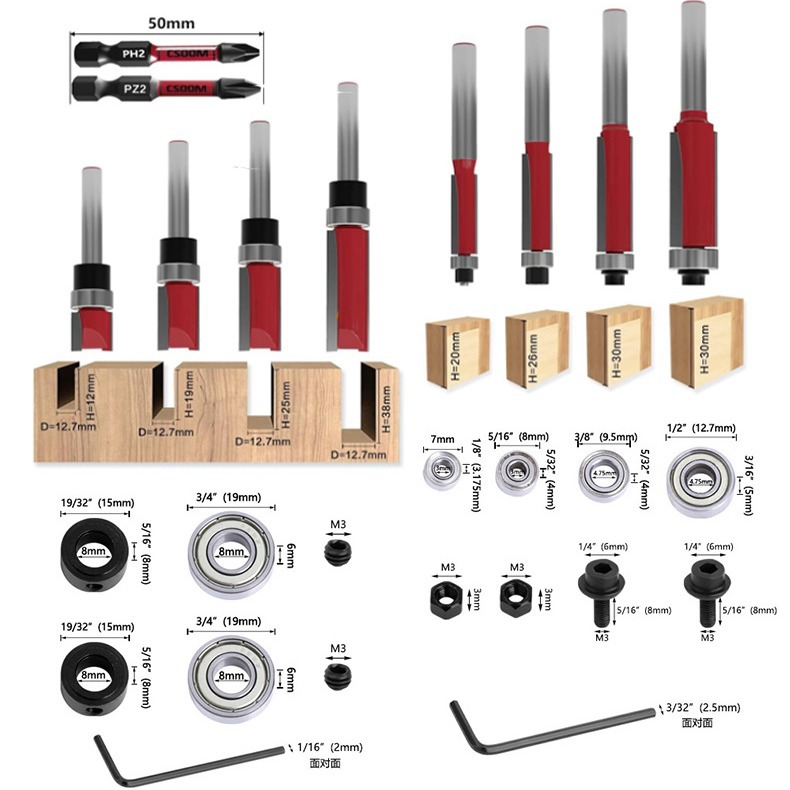
Bearing trim bits are the most fundamental and user-friendly cutting tools for handheld wood trimmers. They are widely used in residential woodworking, cabinet manufacturing, and furniture edge finishing. Unlike ordinary router bits that need auxiliary fences or templates, bearing trim bits have a bottom guide bearing. This bearing slides tightly along the workpiece edge for automatic alignment. The design removes complicated positioning steps and lowers the operating threshold. As a result, these bits are the top choice for beginners and pros who focus on edge trimming and corner shaping. To explore our full range, browse this collection of bearing trim router bits.
This guide explains the structure, core functions, practical applications, and buying tips of bearing trim router bits. By the end, you will understand how to achieve clean and precise wood finishing with confidence.
Key Structural Components of Bearing Trim Bits
To use bearing trim bits well, you must understand their three core components. Each part directly affects cutting stability and finished quality.
The Tool Shank
The shank is the mounting base that connects the bit to the wood trimmer. The two mainstream specifications are 6.35mm (1/4 inch) and 12.7mm (1/2 inch). Both fit most standard handheld trimmers and electric wood routers. A critical rule is that the clamping depth must reach at least 10 millimeters. This prevents tool shaking or popping out during high-speed operation. Therefore, match the shank diameter strictly with your equipment’s chuck size for safe, stable cutting.
Cutter Body and Blades
The cutter body and blades are the core working parts. Premium bearing trim bits use tungsten carbide alloy, which offers excellent wear resistance and anti-stick properties. Consequently, the material resists adhesive residue from PVC edge bands and wood veneers. It is ideal for paint-free boards, MDF, and laminated wood panels. Blades come in single-flute and double-flute designs. Single-flute cutters have light cutting resistance and low noise, plus strong anti-chipping performance. They suit household DIY and novice woodworking. In contrast, double-flute cutters give smoother, flatter surfaces. They generate slightly higher resistance but excel in hardwood and mass production.
Bottom Guide Bearing
The bottom guide bearing is the most distinctive part of trim bits. Installed at the lowest end, it slides against the vertical surface of wood panels. Thus, it accurately controls cutting width and edge radian. Its core value is automatic limiting and positioning, which ensures uniform trimming without deviation during long cuts. Bearings come in single-bearing and dual-bearing versions. Single-bearing models are the most common for daily light trimming because they are simple and affordable. Dual-bearing designs deliver higher accuracy and smoother running, making them suitable for thick panels and high-speed feed cutting.
Practical Uses of Straight Bearing Trim Bits
Straight bearing trim bits are a versatile must-have for whole-house cabinet making and door panel processing. Equipped with straight cutting edges and precision bottom bearings, they trim excess edge banding, clean rough burrs, and straighten irregular board edges. Moreover, they work with PVC edge bands, natural veneers, ecological boards, particle boards, and multi-layer plywood. For family enthusiasts, one straight bearing trim bit handles most daily edge finishing tasks. It has earned a reputation as the most practical all-round cutter for household projects.
How to Choose a Quality Bearing Trim Router Bit
Choosing a high-quality trim router bit improves efficiency and avoids defects. Follow three core principles.
First, prioritize shank diameter matching. Most compact household trimmers use 6mm or 6.35mm shanks, while high-power industrial routers often need 8mm shanks. Complete matching guarantees coaxiality and reduces vibration. Second, inspect bearing quality strictly. Qualified bearings rotate freely without jamming or loosening; inferior ones stall, deviate, and scratch the board. Third, always choose professional tungsten carbide cutter heads instead of ordinary high-speed steel. High-speed steel dulls quickly on edge bands and MDF, causing burrs and frequent replacement. In comparison, carbide bits keep long-term sharpness and stable performance. Before buying, review all Trimming Router Bits to compare specs.
Conclusion
A bearing trim router bit is an essential tool for clean, precise edge work. By understanding its shank, carbide blades, and guide bearing, you can select the right model with confidence. Match the shank to your machine, check bearing quality, and prefer tungsten carbide for durability. With the right bit, both beginners and professionals can finish woodworking projects faster and cleaner.
Frequently Asked Questions
Q1: What is a bearing trim router bit used for?
A1: It trims edge banding, cleans burrs, and straightens board edges on cabinets, doors, and furniture, using a guide bearing for automatic alignment.
Q2: Should I choose a single-flute or double-flute trim bit?
A2: Single-flute bits suit DIY and soft materials with low noise; double-flute bits give smoother surfaces for hardwood and mass production.
Q3: Why is tungsten carbide better than high-speed steel for trim bits?
A3: Carbide resists dulling on edge bands and MDF, keeps sharpness longer, and needs less frequent replacement than high-speed steel.
Q4: How do I match the shank to my trimmer?
A4: Check your machine’s chuck size first; common sizes are 6mm, 6.35mm (1/4 inch), 8mm, and 12.7mm (1/2 inch), then pick the matching shank.