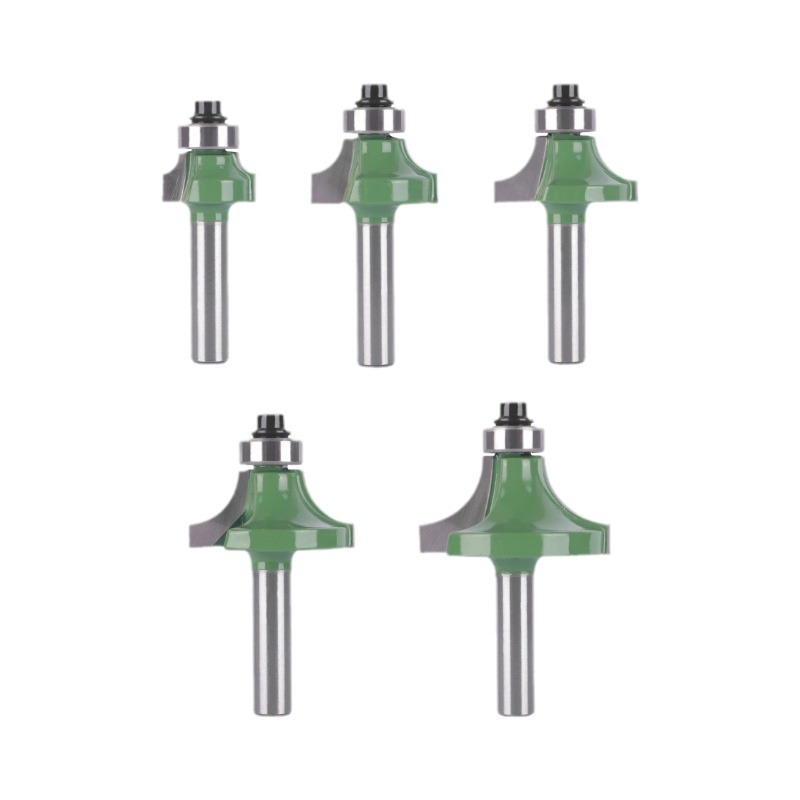
Complete guide to shaped cutters and bearing-guided cutters for wood moulding, jointing and trimming
Woodworking router bits fall into two core categories: shaped cutters and bearing-guided cutters. Mastering the features and applications of these two bit types helps woodworkers select the right tool for moulding, jointing, grooving and edge trimming, improving processing flexibility and cutting precision.
Shaped cutters are mostly designed with a standard two-flute structure, ideal for decorative moulding and wood jointing tasks. These versatile cutters support multi-shape processing with a single tool. By adjusting the cutting depth, cutting width, table fence or side fence position, users can create various wood profiles. Models equipped with ball-bearing guides can achieve new contour processing by replacing larger outer-diameter bearings. Common shaped cutters include dovetail cutters, rounding over cutters, bevel cutters and rebate cutters for grooving and step processing.
Bearing-guided (self-guiding) cutters feature a built-in guiding structure, adopting either ball-bearing assembly or brazed solid guide pins. They can fit closely to workpiece edges and follow template paths accurately. Different from ordinary shaped cutters, self-guiding bits excel in edge trimming, profile shaping and slotting work, requiring no complex positioning calibration.
Choosing between the two bit types depends on processing demands. Shaped cutters suit diverse custom profile production, while bearing-guided cutters ensure stable, repeatable precision for edge finishing and template routing, covering most daily woodworking and furniture manufacturing scenarios.